
AI and work: the real gap is not between generations, but between adoption and perception.
Over the past two years, artificial intelligence has become one of the most talked‑about topics in the world of work.
Between those who see it as an imminent revolution and those who view it with scepticism, the debate often falls back on a familiar contrast: young people versus seniors, digital natives versus older generations.
However, the data collected in the People & Work 2026 report, based on a survey of more than 1,500 people across Italy carried out by AxL – Agenzia per il Lavoro, paint a more nuanced picture.
The most interesting element is not who is using AI, but who is not using it yet – and, above all, how different generations imagine its impact on the future of work.
AI is here – but not yet widespread
Looking at the use of artificial intelligence in job search, a generational difference does appear, but it is far less dramatic than one might expect.
Generation Z shows the highest level of use (31%), followed by Millennials (28.4%), Generation X (24.2%) and Baby Boomers (22.9%).
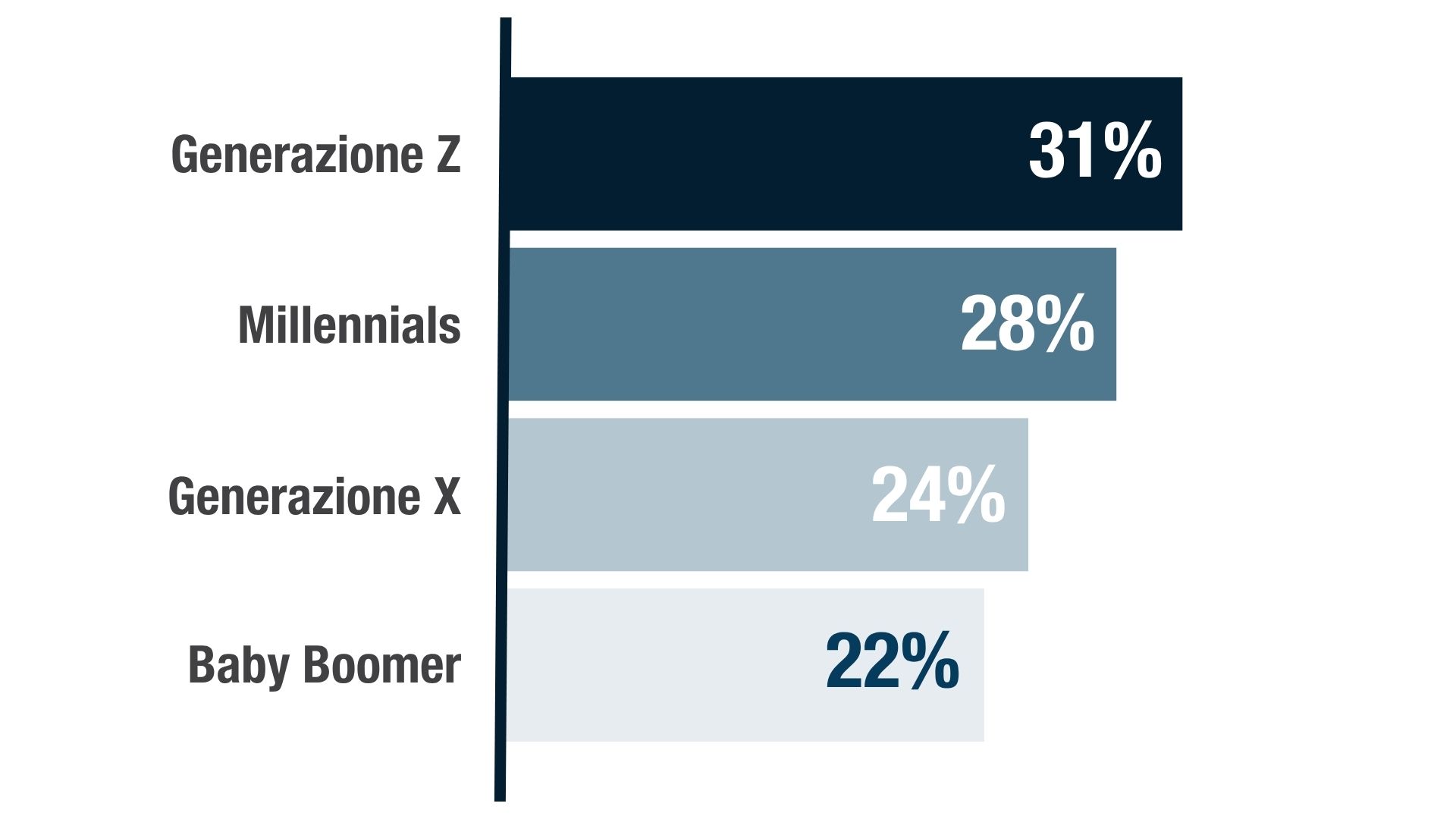
This confirms that younger people adopt these tools more frequently; however, the distance between generations is relatively small and there is no clear “technology divide”.
What we see instead is a gradual adoption curve that runs across all age groups.
The most telling figure is who is not using it
While public discussion often focuses on those experimenting with AI, the data suggest we should look the other way.
In every generation, the majority of survey participants say they do not use AI in their job search.
Specifically:
-
69% of Generation Z (born between 1997 and 2012)
-
71.6% of Millennials (born between 1981 and 1996)
-
75.8% of Generation X (born between 1965 and 1980)
-
77.1% of Baby Boomers (born between 1946 and 1964)
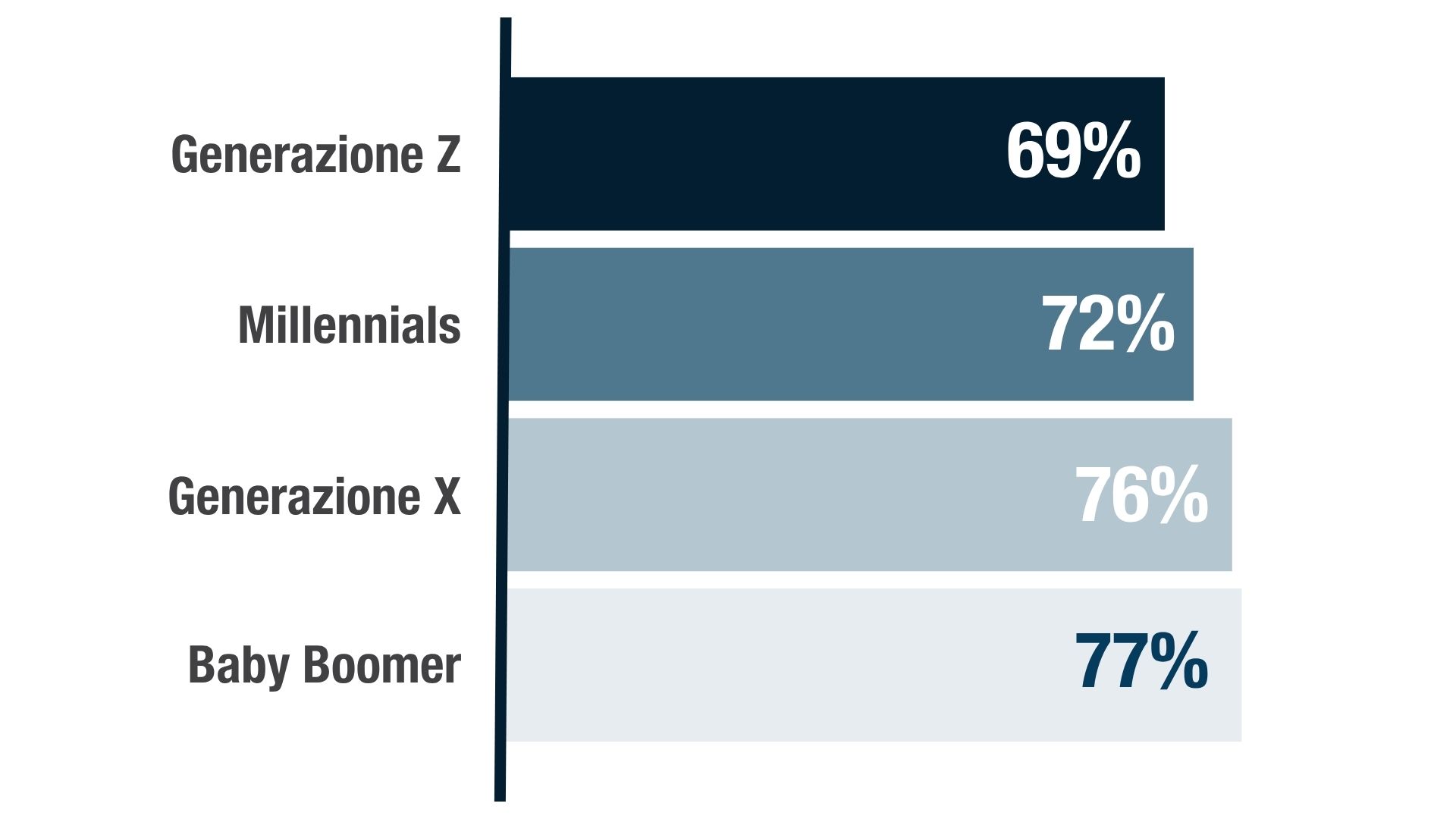
The generational gap exists, but what stands out most is the overall size of the phenomenon.
Adoption is still a minority behaviour in all age groups, regardless of education level.
When people do use AI, they use it for very practical reasons
Another interesting insight concerns how AI is used.
Artificial intelligence is not primarily used to “try out” new technologies or out of pure curiosity.
People turn to it for very concrete tasks:
-
improving their CV
-
analysing job opportunities
-
gathering information about companies
-
checking and showcasing their skills
AI therefore appears mainly as a practical tool, used to tackle immediate needs and improve the effectiveness of job‑search activities.
More than innovation for its own sake, what emerges is a logic of usefulness.
Differences show up more clearly in how people see the future
While actual usage patterns do not differ dramatically, expectations and fears about AI diverge more strongly.
Generation X expresses the highest level of concern about AI reducing job opportunities, followed by Millennials.
Generation Z is more open and less alarmed, while the most surprising result concerns Baby Boomers, who are in fact the most optimistic about the opportunities that AI could create.
One possible interpretation is that those in the middle of their careers feel the potential impact of technological change on their roles and skills more directly.
Those closer to entering or exiting the labour market tend to look at the phenomenon from a different vantage point.
A cultural issue before a technological one
Taken together, the analysis suggests an important conclusion.
AI adoption does not depend solely on age or digital familiarity; people are more likely to use new technologies when they understand their concrete value and can integrate them into their professional routines.
For this reason, AI appears less and less as a purely technological topic and more as a cultural one.
The key issue is not just access to tools, but the ability to understand their role and impact in everyday work.
From interest to adoption
What, then, do the data tell us?
That artificial intelligence has clearly entered the conversation about work, but has not yet become a widespread practice.
It cuts across all generations, but does not divide them in a hard line.
The most meaningful differences do not lie in digital skills, but in how people interpret change and imagine the future.
For organisations, this means going beyond simply rolling out new tools, and instead actively supporting their adoption – making benefits, limits and opportunities clear to everyone.